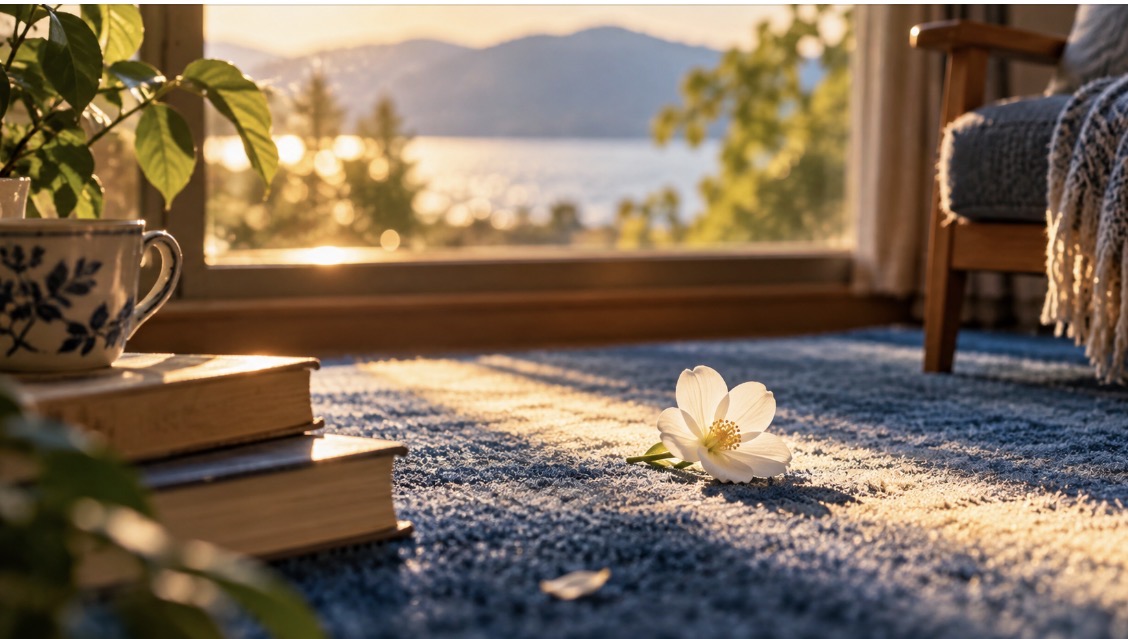
One day, I noticed a white flower on a blue carpet, glowing brightly in a shaft of sunlight. I sat quietly watching it, but little by little, the flower began to dim. The sunlight was slowly moving away.
The flower had not moved. The carpet had not moved. Neither had I. And yet, the Earth was turning, and time was passing. In those fleeting moments, I could almost feel time itself moving.
In one sense, we are rich from the moment we are born, for we are given sunlight, and we grow through its endless alternation of light and darkness. In another sense, there is something profoundly sad about being human, for from the moment we enter this world, we are also moving toward the end of our lives, one sunrise and sunset at a time.
Time is so fine that we cannot see it, yet in each of our lives, it traces a line with a beginning and an end. Time is also vast, as wide as a river rushing endlessly forward. Its fineness reminds us of the fragility of life; its breadth reveals the richness of living.
We cannot determine the length of our lives, but we can try to expand their breadth.
Rather than dwelling on how fragile and fleeting time is, I would rather fill the time I have with as much life as possible.
When I spend an hour on the phone with an elderly person who lives alone, when I play ball for two hours, when I spend several hours playing mahjong with friends, when we gather and talk away an entire afternoon, or when I listen to a song over and over again on the campus shuttle, hoping to sing it beautifully at a wedding, I feel that I am expanding the breadth of my life.
Some of these things are significant; others may seem quite ordinary, perhaps even inconsequential. But isn’t that what life is made of? Joy, companionship, learning, giving, and the memories we gather almost without noticing—all of these enrich a life that might otherwise seem like nothing more than a line stretching from beginning to end.
Yet time has one extraordinary quality: once it is gone, it can never be recovered.
Money can be earned again. Things we give away can be replaced. But time, once spent, is gone forever.
That is why I am especially grateful to those who have given me their time.
Those who quietly sit beside me while I eat. Those who take the time to call when I am ill. Those who sit with me by a lake, doing nothing in particular. Those who put aside their own work to help me test and verify research results when I need assistance.
These may seem like small, ordinary gestures. Yet the more I think about them, the more precious they become.
For time is one of the most valuable gifts one person can give another.
An afternoon a friend spends with me is also an afternoon of that friend’s own life. By spending it with me, my friend has given me a part of that life. And when I sit and talk with a friend, my own life is passing, minute by minute. I, too, am giving that friend a part of mine.
What an extraordinary weight such companionship carries.
When you need someone to be with you, you ask a friend, “Do you have time?”
“Yes,” your friend replies. “I have time.”
But what does it really mean to have time?
We all have only twenty-four hours in a day. Work takes time. Eating takes time. Sleeping takes time. There are parents, children, and spouses to care for, unfinished responsibilities, places we long to visit, books we hope to read, and lives of our own that we wish to live.
So when someone says, “I have time,” what they often really mean is:
I am willing to set aside a little of my time for you.
And that little bit of time is also a part of their finite life.
Yet friendship is not simply a matter of one person giving and another receiving.
When I spend an hour talking with an elderly person who lives alone, perhaps I have given that person an hour of companionship. But during that same hour, I, too, have experienced the warmth of human connection. When my friends and I run around a court together, or sit around a mahjong table laughing and talking, we are giving our time to one another, and sharing the happiness that comes with it.
I have come to realize that giving time to others does not necessarily leave us with less. Quite the opposite. Often, it is through companionship that our limited lives become richer.
Time cannot be returned, but it can be shared.
Life cannot always be made longer, but through sharing, it can become wider.
And some moments, though long past, seem never to disappear.
Years from now, you may have forgotten what gifts your friends once gave you, but you may still remember an afternoon when a friend sat beside you in the sunlight. You may remember a friend driving over to see you when you were ill, a leisurely walk with no particular destination, or a drive along the highway while listening together to The Three-Body Problem. You may remember…
Those hours have passed, yet somehow they have not truly vanished.
They have been transformed from hours measured by a clock into memories woven into our lives.
And time that once belonged to only one person, through the simple act of being together, has found a lasting place in two lives.
I am reminded of a book by the Chinese film director Feng Xiaogang, titled I Offer You My Youth. Youth is only one chapter of life, but time accompanies us throughout our entire existence.
When we are young, we tend to believe that there will always be plenty of tomorrows. As we grow older, we gradually come to understand that what matters most is not how much time we have left, but how we choose to spend it, and with whom we choose to share it.
And so, I treasure the friends who have given me their time, just as I am willing to give them mine.
If one day I wish to express my deepest affection for a friend, I would like to say:
I give you my time.