The brain is often described with impressive numbers.
It contains tens of billions of neurons, an even larger population of supporting cells, and an almost unimaginable number of connections. It allows us to recognize a face, understand a sentence, move a hand, feel afraid, remember a song, and imagine a future that has not happened yet.
Those numbers are remarkable. But they can also make neuroscience feel like a subject reserved for specialists.
It does not have to feel that way.
You do not need to memorize every brain region or pronounce every chemical name to understand the central ideas. Neuroscience begins with a few beautiful principles: brain cells communicate, connections form networks, experience changes those connections, and everything the brain does is shaped by its relationship with the body and the world.
The details are complex. The basic story is human.
The brain is made of living cells
The brain is not a computer sealed inside the skull. It is living tissue.
Its best-known cells are neurons. A neuron receives information through branching structures called dendrites, processes that information in its cell body, and sends signals along a long fiber called an axon.12
Inside the neuron, signals travel electrically. When a signal reaches the end of an axon, the neuron usually communicates with the next cell by releasing chemical messengers called neurotransmitters.
The tiny space where one cell communicates with another is called a synapse.
A single neuron may receive messages from thousands of other cells. Some messages make it more likely to send its own signal; others make it less likely. What the neuron does depends on the pattern arriving from the larger network.
Neurons do not work alone. The brain also contains glial cells, once treated mainly as biological support material. We now know that glia help nourish neurons, form and maintain synapses, insulate nerve fibers, regulate the environment around cells, participate in immune responses, and influence neural activity.25
The brain is therefore not a collection of tiny wires. It is a living community of cells continually supporting, regulating, and responding to one another.
The message is both electrical and chemical
If you touch something hot, sensory cells send information through nerves toward the spinal cord and brain. Networks process the signal, contribute to the experience of pain, and help organize a response. Motor pathways send instructions back toward the muscles so that your hand can move away.
This can happen extraordinarily quickly.
But a neural signal is not a miniature thought traveling through the brain. There is no tiny image of the hot surface moving from cell to cell. Meaning emerges from patterns of activity distributed across many neurons and brain regions.
The same principle applies when you hear a familiar voice. Sound waves are converted into neural signals, but recognizing the speaker requires much more than hearing. The brain compares the incoming pattern with stored knowledge, emotional associations, context, and expectations.
What feels like one effortless moment is the work of many systems cooperating.
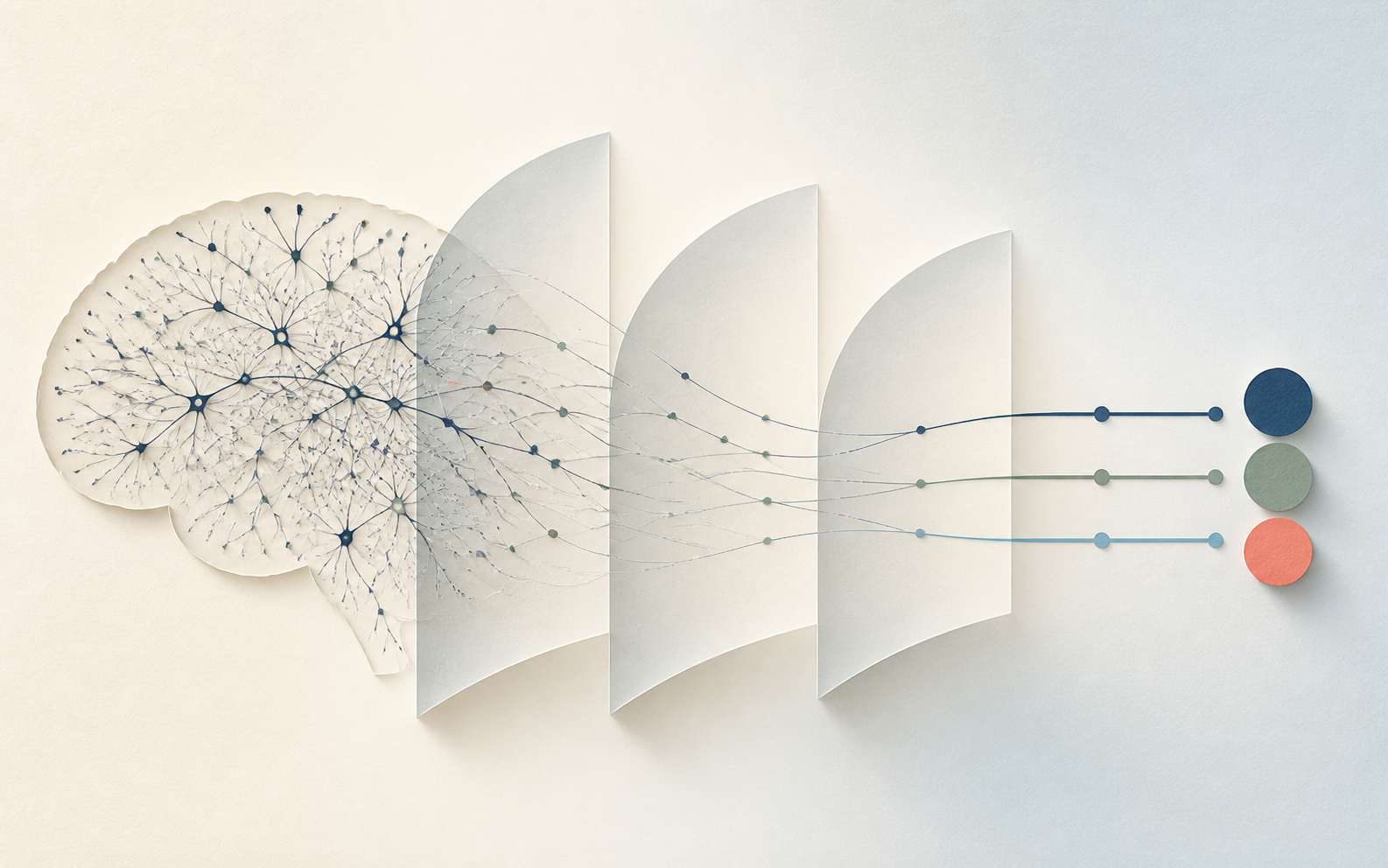
The brain works through networks
Popular diagrams divide the brain into colored regions and assign each one a job: vision here, language there, memory somewhere else.
These maps can be useful. Different regions do have specialized anatomy and make distinct contributions. Damage to a particular area can produce a particular difficulty.
But complex experiences are rarely created by one region acting alone.
Reading a sentence involves visual processing, attention, language, memory, learned knowledge, and prediction. Making a cup of tea involves vision, movement, planning, object recognition, timing, and an understanding of what comes next.
Modern neuroscience increasingly studies the brain as a network operating across multiple levels—from molecules and individual synapses to local circuits and widely distributed brain systems.3 Recent research suggests that information involved in cognition may be represented broadly across the brain, although not every region contributes in the same way.4
A useful metaphor is an orchestra.
Different instruments have different roles. Some carry the melody, some maintain rhythm, and some enter only at a particular moment. But the music belongs to their coordination, not to one instrument.
The brain is always interpreting
The senses do not provide a perfect recording of the outside world.
Light reaches the eyes. Vibrations reach the ears. Pressure, temperature, and chemical signals arrive from the skin and internal organs. The brain must turn this incomplete information into a useful understanding of what is happening.
It does this partly by combining new sensory evidence with context, prior experience, and expectation.
This is why the same shadow may look harmless in daylight and threatening at night. It is why we can understand a sentence even when a letter is missing, or hear our name in a noisy room.
Perception is not simply receiving the world. It is the brain's best current interpretation of the world.
Most of the time, this process is remarkably effective. But because interpretation depends on context, attention, and experience, two people can encounter the same event and honestly perceive it differently.
The brain is not trying to create a flawless copy of reality. It is trying to help the body understand enough to respond.
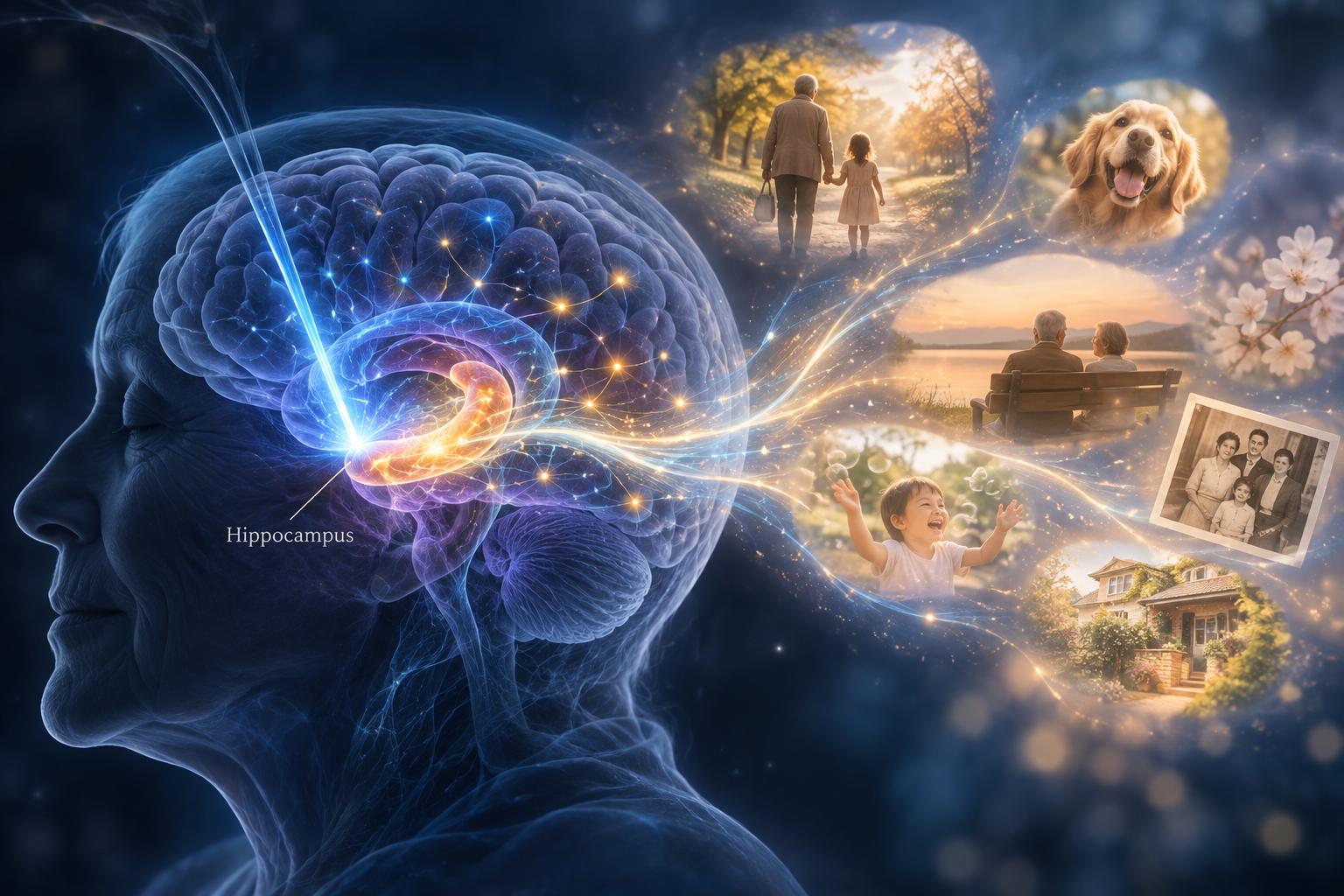
Memory is a reconstruction, not a recording
We often imagine memory as a library or video archive. An experience is stored, and later we retrieve the same event.
Human memory is more active than that.
When we remember, the brain rebuilds an experience from pieces: sensory details, meaning, emotion, knowledge, and information encountered later. This constructive process makes memory flexible, but it also makes it vulnerable to distortion.7
Forgetting a detail does not necessarily mean the entire memory has disappeared. A smell, photograph, familiar place, or piece of music may provide a cue that helps the network reconstruct it.
Each act of remembering can also affect what is remembered later. Memory is not only about preserving the past. The same constructive system helps us imagine possible futures, prepare for situations, and make decisions.7
This is why ordinary memory errors are not proof that the brain has stopped working. They are sometimes a consequence of how an adaptive memory system normally operates.
At the same time, persistent or worsening memory changes that interfere with daily life deserve medical attention. Normal reconstructive memory and neurological disease are not the same thing.
Emotion and reason are partners
Another familiar story divides the brain into a rational system and an emotional system, as if good decisions require one to defeat the other.
Neuroscience presents a more integrated picture.
Emotion helps the brain decide what matters. Fear directs attention toward possible danger. Pleasure encourages us to repeat useful actions. Sadness can draw attention to loss. Affection shapes trust, care, and social connection.
Reasoning also changes emotion. The meaning we give an event can calm or intensify the body's response.
Complex emotional and cognitive behavior depends on dynamic interactions among overlapping brain networks rather than a clean separation between "thinking regions" and "feeling regions."8
An emotion is not "just in your head," either. The brain continually receives information from the heart, lungs, digestive system, muscles, hormones, and immune system. A racing heart can influence the experience of fear; hunger can change attention and patience; pain can narrow the world.
Mind and body are not separate departments. They are in constant conversation.
The brain changes with experience
One of neuroscience's most hopeful ideas is plasticity: the nervous system's capacity to change its structure, activity, or connections in response to experience and internal conditions.6
Learning a skill changes the efficiency and organization of neural pathways. Repeated practice can strengthen some connections, while connections used less often may weaken or be reorganized. Changes can also involve glial cells and the myelin that helps signals travel efficiently.10
Plasticity continues throughout life, although its form and pace change with age.
It also has limits. Plasticity does not mean the brain can recover from every injury if someone simply tries hard enough. Recovery depends on the type and location of damage, health, treatment, environment, time, and many other factors.
Nor is every form of plasticity helpful. The brain can learn persistent fear, reinforce an addiction, or maintain patterns involved in chronic pain.6
Plasticity means the brain is responsive—not infinitely controllable.
This distinction matters because people should never be blamed for symptoms that effort alone cannot change.
The brain uses rest as well as effort
A brain that appears to be "doing nothing" is not inactive.
When attention is not fixed on an outside task, networks remain busy supporting memory, self-reflection, social understanding, and imagination about the future. One group of interacting regions involved in these internally directed processes is often called the default network.11
Sleep is also an active biological state. Across different stages of sleep, brain activity changes in organized ways that support learning, memory, emotional regulation, metabolism, and other essential functions.
Rest is therefore not the opposite of brain function.
Daydreaming, quiet reflection, and sleep are not empty spaces between productive moments. They are part of the rhythm through which the brain processes experience and prepares for what comes next.
There is no "left-brained" or "right-brained" person
The brain's two hemispheres are not identical. Some functions show meaningful lateralization. Language, for example, relies more heavily on left-hemisphere networks in many people, while some aspects of spatial attention rely more heavily on the right.
But the popular idea that one person is logical because they are "left-brained" and another is creative because they are "right-brained" is not supported by neuroscience.9
Logic, creativity, language, music, and emotion depend on networks that communicate across both hemispheres.
The same is true of the claim that we use only 10 percent of the brain. Brain regions may not all be maximally active at the same moment, but normal life depends on activity distributed throughout the brain over time. Even during rest and sleep, the brain remains metabolically active.
Simple brain myths are attractive because they make a complicated organ feel easy to categorize. But the real brain is more interesting: specialized, interconnected, dynamic, and different in every person.
A brain is part of a life
Neuroscience can measure electrical signals, blood flow, chemicals, cells, and behavior. These measurements help explain how the brain works and what changes in illness.
But a brain never exists in isolation.
It develops within a body, a family, a culture, and an environment. Language changes it. Relationships change it. Stress, safety, education, sleep, illness, movement, and opportunity all leave traces.
Two brains can respond differently to the same event because they carry different histories.
This does not make neuroscience less scientific. It makes the science more complete.
A scan can reveal something important about brain structure or activity. It cannot, by itself, tell us the full meaning of a person's fear, memory, love, or loss.
The measurements matter.
The person matters too.
Understanding without intimidation
Neuroscience still contains enormous unanswered questions.
Scientists do not yet have a complete explanation of consciousness. They cannot fully describe how the activity of cells becomes a private experience or why the same biological change affects different people differently.
Uncertainty is not a failure of science. It is an honest description of where knowledge ends and investigation continues.
The central ideas are already powerful:
The brain is alive. Its cells communicate. Its networks cooperate. Its memories are reconstructed. Its emotions and reasoning are intertwined. Its connections change with experience. And every brain is shaped by the life around it.
You do not need to know every anatomical term to begin understanding your own brain.
Sometimes understanding begins with something much simpler: curiosity without fear, an explanation without jargon, and the recognition that behind every neural pathway is a person trying to make sense of the world.
References
- National Institute of Neurological Disorders and Stroke. Brain Basics: Know Your Brain. ninds.nih.gov
- National Institute of Neurological Disorders and Stroke. Brain Basics: The Life and Death of a Neuron. ninds.nih.gov
- Bassett, D. S., & Sporns, O. (2017). Network neuroscience. Nature Neuroscience, 20, 353–364. https://doi.org/10.1038/nn.4502
- Rosen, M. C., & Freedman, D. J. (2026). How distributed is the brain-wide network that is recruited for cognition? Nature Reviews Neuroscience, 27, 138–150. https://doi.org/10.1038/s41583-025-00992-5
- Cahill, M. K., Collard, M., Tse, V., et al. (2024). Network-level encoding of local neurotransmitters in cortical astrocytes. Nature, 629, 146–153. https://doi.org/10.1038/s41586-024-07311-5
- Margetis, K., & Vadakekut, E. (2026). Neuroplasticity. StatPearls. National Library of Medicine. ncbi.nlm.nih.gov
- Schacter, D. L. (2012). Constructive memory: Past and future. Dialogues in Clinical Neuroscience, 14(1), 7–18. https://doi.org/10.31887/DCNS.2012.14.1/dschacter
- Pessoa, L. (2008). On the relationship between emotion and cognition. Nature Reviews Neuroscience, 9, 148–158. https://doi.org/10.1038/nrn2317
- Corballis, M. C. (2014). Left brain, right brain: Facts and fantasies. PLOS Biology, 12(1), e1001767. https://doi.org/10.1371/journal.pbio.1001767
- Xin, W., & Chan, J. R. (2020). Myelin plasticity: Sculpting circuits in learning and memory. Nature Reviews Neuroscience, 21, 682–694. https://doi.org/10.1038/s41583-020-00379-8
- Buckner, R. L., & DiNicola, L. M. (2019). The brain's default network: Updated anatomy, physiology and evolving insights. Nature Reviews Neuroscience, 20, 593–608. https://doi.org/10.1038/s41583-019-0212-7